Brentford
Brave New WorldBrentford is the site of the Television Corporation’s factory, where a brief stop on the return journey to London exposes the ordinary machinery of the World State’s labor system. At the factory’s monorail station, the Savage sees a mass of workers leaving their shift and receiving soma in small cardboard boxes: the scene makes social control tangible as a routine reward distributed at the end of work.
Factory and Setting
On their way back to London, Bernard and the Savage stop at the Television Corporation’s factory at Brentford. Bernard asks the Savage to wait while he makes a telephone call, leaving him to observe the workers as the Main Day-Shift ends and the crowd gathers at the monorail station.
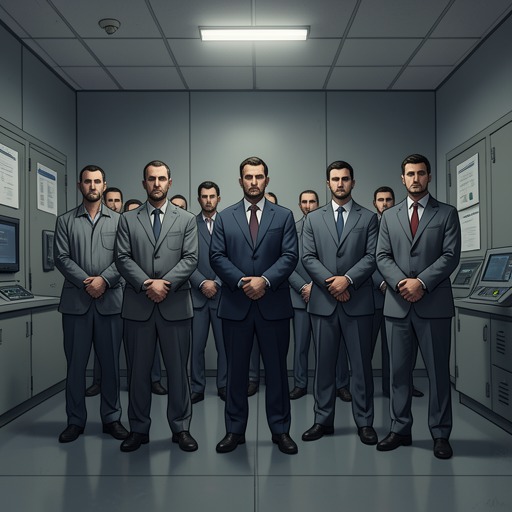
The crowd consists of seven or eight hundred Gamma, Delta, and Epsilon men and women. The Savage notices how few differences there are among them: across the entire group, there are no more than a dozen distinct faces and statures. The factory thus appears not simply as a workplace but as a setting where the World State’s mass organization of labor is visible in the people moving through it.
Soma Distribution
As the workers queue with their tickets, the booking clerk pushes a small cardboard pillbox to each person. The line advances slowly, described as a long caterpillar of men and women. Its movement turns a standardized transaction into a collective spectacle: worker after worker receives the same substance as the workday ends.
When Bernard returns, the Savage asks what the boxes contain, recalling the caskets in Shakespeare’s The Merchant of Venice. Bernard explains that they hold the day’s soma ration. Workers receive it after work: four half-gramme tablets on an ordinary day and six on Saturdays. The doses and the Saturday increase make the distribution precise and scheduled, not an incidental gift.
Narrative Significance
The Brentford episode links industrial labor to soma as an organized form of social pacification. The drug is handed out at the point where the shift ends, integrating relief or escape into the routine of work. The contrast between the nearly indistinguishable crowd and the individually issued pillboxes gives the scene its central tension: each worker receives a separate ration, but the system treats the many as a uniform mass.
The Savage’s question makes this routine newly visible. What the factory’s workers accept as an ordinary part of leaving work appears strange enough to invite comparison with literary caskets; Bernard, by contrast, answers matter-of-factly while chewing Benito Hoover’s gum. Brentford therefore serves as a compact encounter between the Savage’s questioning perspective and a society in which labor, consumption, and emotional management are administered as predictable parts of the same order.